A Cross-University Academic Couple Advancing High-Performance Peptide Synthesis from Research to Industry
Professor Chia-Lin Kao of Kaohsiung Medical University and his wife, Professor Hui-Ting Chen of National Yang Ming Chiao Tung University, are not only life partners but also long-term academic collaborators. Through sustained cross-university cooperation in the field of high-performance peptide synthesis and ligation technologies, the couple has successfully integrated expertise in biomedical research and chemical synthesis, achieving remarkable progress in both academic innovation and industrial application in recent years.
Leveraging their jointly developed High-Performance Specialty Peptide Synthesis Technology, the research team was selected twice for Taiwan’s National Science and Technology Council (NSTC) “Germination Grant Program”, in the 2024-2 and 2026-1 funding cycles, receiving grants of NTD 6 million and NTD 5.6 million, respectively. In addition, the team was honored with the 22nd National Innovation Award – Academic Research & Startup Category, underscoring strong recognition of the technology’s maturity and commercialization potential.
A High-Performance Peptide Platform Integrating Solid-Phase Synthesis and Ligation
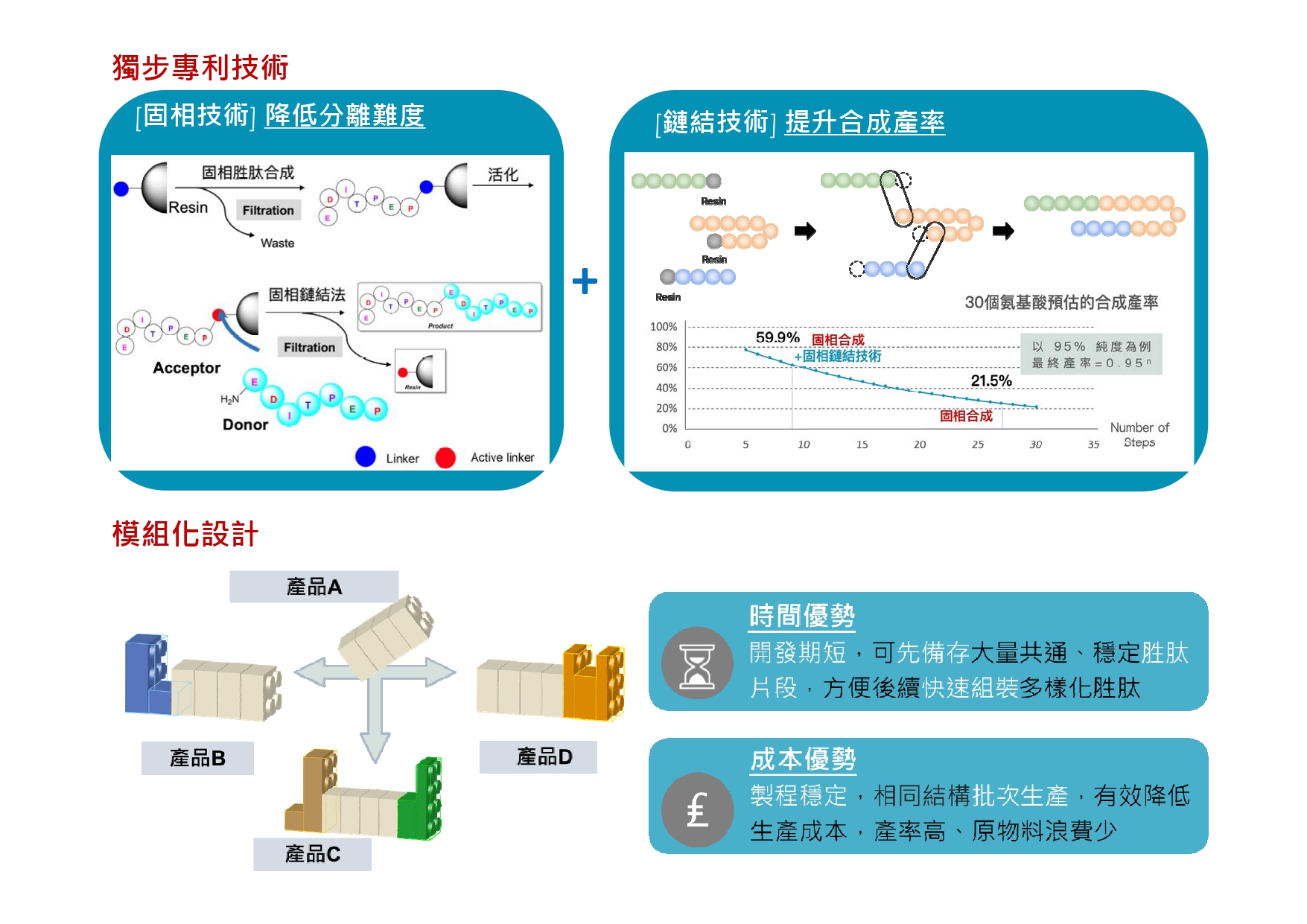
Combining their respective strengths in peptide design, chemical synthesis, and process optimization, Professors Kao and Chen jointly established an innovative solid-phase peptide synthesis and ligation platform. This technology pioneers the simultaneous synthesis and ligation of peptide fragments directly on solid-phase resin, effectively overcoming key limitations of conventional peptide manufacturing—such as low yields for long-chain peptides, purification difficulties, and excessive by-products.
Key advantages of the platform include:
· Significant improvement in peptide yield and purity
· Substantial simplification of separation and purification processes
· Establishment of a modular peptide fragment library to support small-batch, high-diversity demands
· Applicability to a wide range of structures, including linear, cyclic, branched, amphiphilic peptides, and peptide–drug conjugates
Through years of close collaboration and strong mutual understanding, the academic couple has successfully transformed laboratory-scale innovations into a stable, scalable, and platform-based technology, providing critical technical support for early-stage drug development and precision medicine.
Addressing Industry Challenges and Bridging Academia and Industry
During the preclinical development stage, peptide-based drugs often face challenges such as small production volumes, diverse product specifications, and compressed development timelines. Large CDMOs are typically reluctant to accommodate small-batch orders, while research institutions and drug developers urgently require high-quality peptide intermediates and impurity reference standards.
The platform developed by Professors Kao and Chen offers milligram-to-gram-scale pilot production capability, with reliable supply of API intermediates and key reference materials. This effectively fills a critical gap in the peptide supply chain and serves as an essential bridge connecting academic research with industrial application.
The Significance of Dual Grant Program Awards and the National Innovation Award
Receiving funding from two rounds of the NSTC Germination Grant Program, together with recognition from the 22nd National Innovation Award – Academic Research & Startup Category, not only highlights the long-term technical expertise accumulated by Professors Kao and Chen in peptide chemistry but also demonstrates that their technology is well-positioned to transition toward commercialization and real-world industrial deployment.
Advancing a New Era of Medicine Through Cross-University Spousal Collaboration
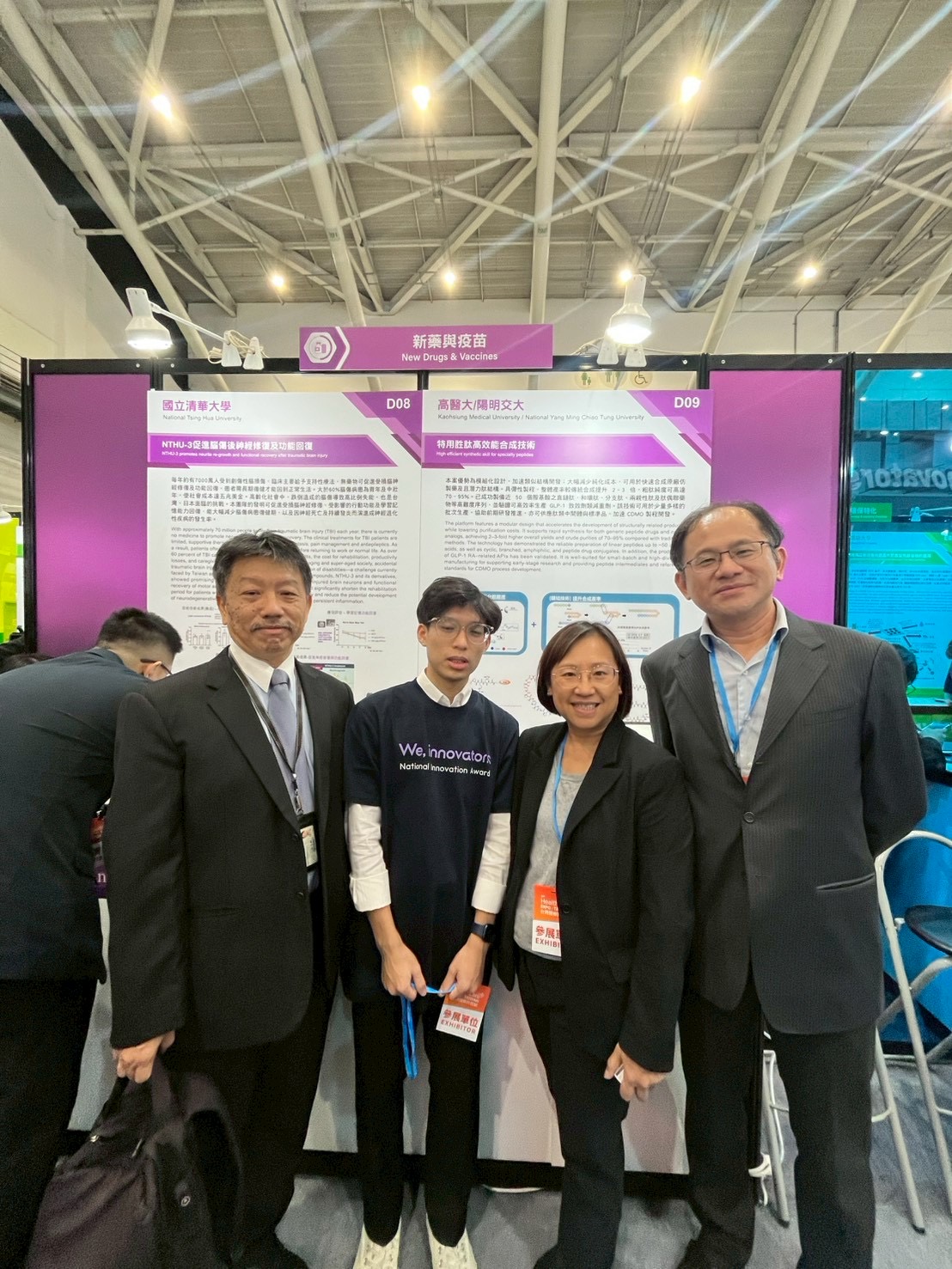
Looking forward, Professors Kao and Chen will continue to leverage their cross-university spousal collaboration model to further integrate key aspects of peptide manufacturing, including process scale-up, quality consistency, and regulatory alignment. By combining complementary strengths from different academic systems and disciplines, the team aims to accelerate the translation of specialty peptide technologies from research into practical applications.
Their long-term vision is to become a key technology partner for early-stage drug developers and CDMOs, while driving the emergence of a new era of medicine through systematic, scalable innovation—contributing to the sustainable growth and global competitiveness of Taiwan’s high-value biomedical industry.