A Critical Point in Clinical Decision-Making: Redefining the Role of Medical Imaging
In today’s healthcare system, the Department of Medical Imaging functions much like an intelligence analysis center for clinical decision-making. Every day, it receives a constant stream of imaging data, including X-rays, computed tomography (CT), and magnetic resonance imaging (MRI). Radiologists must analyze and interpret these images within a very limited timeframe, providing essential information that supports frontline clinicians in diagnosis and treatment. This role is particularly critical in emergency care. In recent years, however, the rapid growth in imaging volume has placed increasing interpretive pressure on medical imaging departments. Physicians are required to complete a large number of highly complex reads under significant time constraints, creating substantial demands on both professional expertise and sustained concentration.
Highly Complex Interpretation: The Clinical Challenge of Bowel Obstruction Imaging
Bowel obstruction is a clear example of this challenge. Its clinical presentation is variable, and image interpretation can be highly demanding. Unlike pneumothorax or intracranial hemorrhage, which often present with more clearly defined imaging features, bowel obstruction cannot be determined by a single imaging sign. Instead, radiologists must integrate multiple imaging findings, including the degree of bowel dilatation, the location of the transition point, the pattern of bowel contents, bowel wall changes such as edema or ischemia, changes in mesenteric fat, and the presence of ascites or free air. These findings are highly heterogeneous and may vary significantly across different disease stages, requiring spatial anatomical understanding as well as clinical experience and inference. Yet bowel obstruction is an emergency condition, and some patients require surgical intervention. Delayed treatment may lead to bowel necrosis, perforation, sepsis, and life-threatening outcomes. Non-immediate reporting can therefore result in diagnostic delay, particularly during nights, holidays, or periods of limited medical staffing.
From Clinical Problem to AI Solution: The Starting Point of Product Development
In response to this clinical need, a team led by Dr. Huei-Yi Tsai from the Department of Medical Imaging at Kaohsiung Medical University Chung-Ho Memorial Hospital, working in collaboration with the Medical AI Innovation and Application Center, developed the “An Artificial Intelligence–Based Abdominal Computed Tomography (CT) Detection and Diagnostic Assistance Software for Intestinal Obstruction.” The software automatically analyzes abdominal CT images and identifies lesion locations, helping radiologists rapidly recognize suspected bowel obstruction cases and prioritize interpretation. In the final validation stage, the model demonstrated strong predictive performance, achieving a precision of 0.986, indicating an extremely low false-positive rate when identifying positive cases. In addition, its mAP@50 reached 0.994, showing high concordance between the model’s lesion localization and the ground-truth annotations, and demonstrating its ability to accurately mark suspected obstruction areas. With this level of performance, the AI system has potential not only as an interpretation support tool, but also as a clinical triage system.
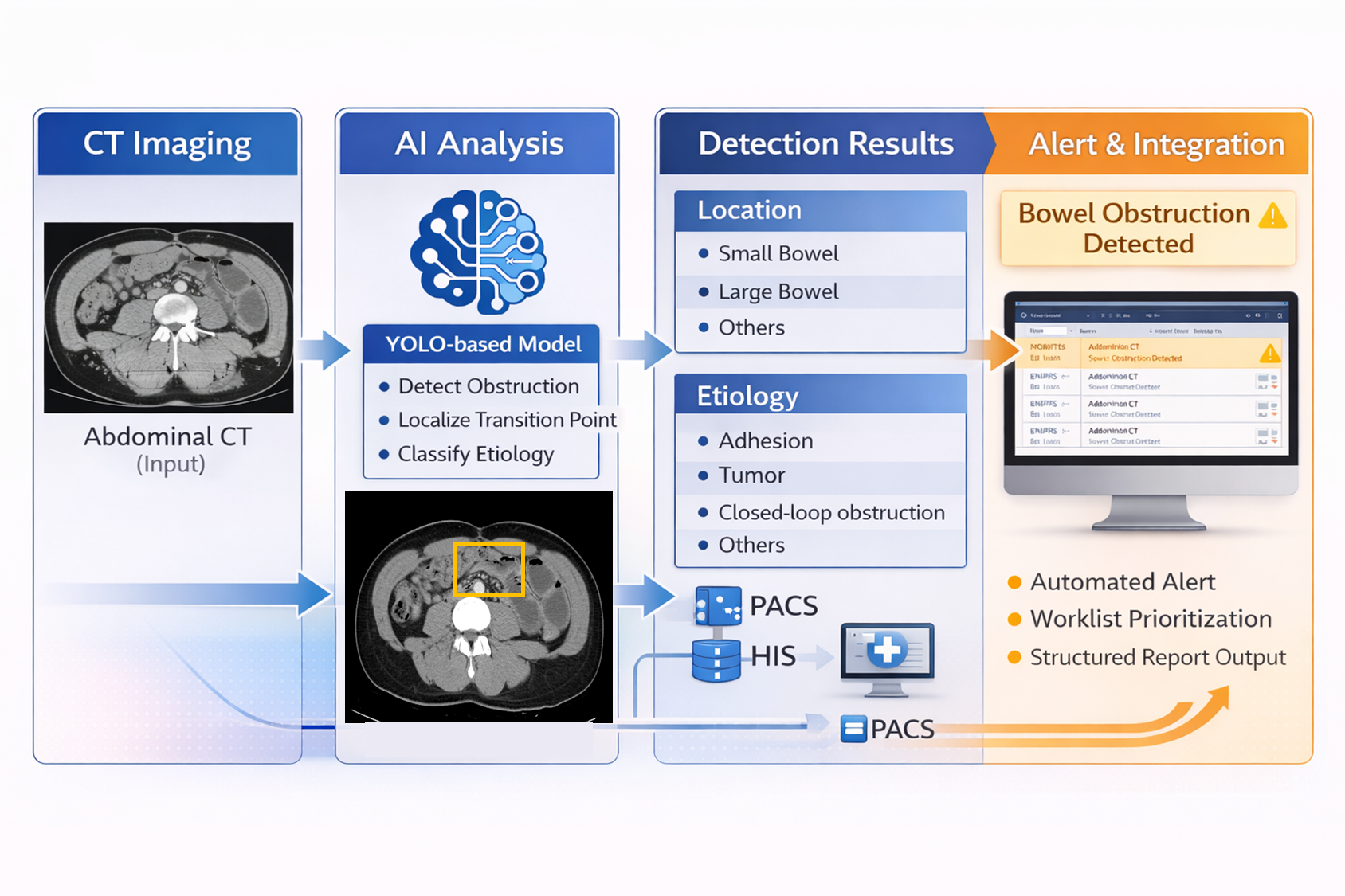 An Artificial Intelligence–Based Abdominal Computed Tomography (CT) Detection and Diagnostic Assistance Software for Intestinal Obstruction
A Systematic Translation Mechanism: From Research to Commercialization
Along the translation and productization pathway, the project received guidance from the Office for Operation of Industry and University Cooperation and advanced through the systematic KMU SPARK cultivation mechanism. By integrating clinicians, engineering teams, and academia-industry resources, the project progressed step by step toward commercialization. From product definition, clinical validation design, and regulatory pathway assessment for smart medical devices to patent strategy and industry matchmaking, the case formed a comprehensive translational development process. Notably, the project has filed patent applications in both the United States and the Taiwan, and has successfully completed technology transfer. This milestone brings university-based research outcomes into the industrial ecosystem and moves the technology toward market application. Through the technology transfer mechanism, industry partners can now take over the next phase of implementation, supporting the critical transition from research output to clinical product.
Recognition from Both Clinical and Industrial Perspectives: Achievements and Future Development
This product received the Clinical Innovation Award at the 22nd National Innovation Award in 2025, underscoring its recognized value in clinical application and innovation potential. At the same time, the completion of technology transfer indicates that the technology has established a foundation for industrialization and may be further expanded into broader medical settings. Future development will focus not only on continued optimization of model performance, but also on extending the platform to related bowel imaging analysis, with the longer-term goal of building a comprehensive intelligent abdominal imaging analysis platform that improves the efficiency and quality of imaging interpretation for acute bowel conditions.
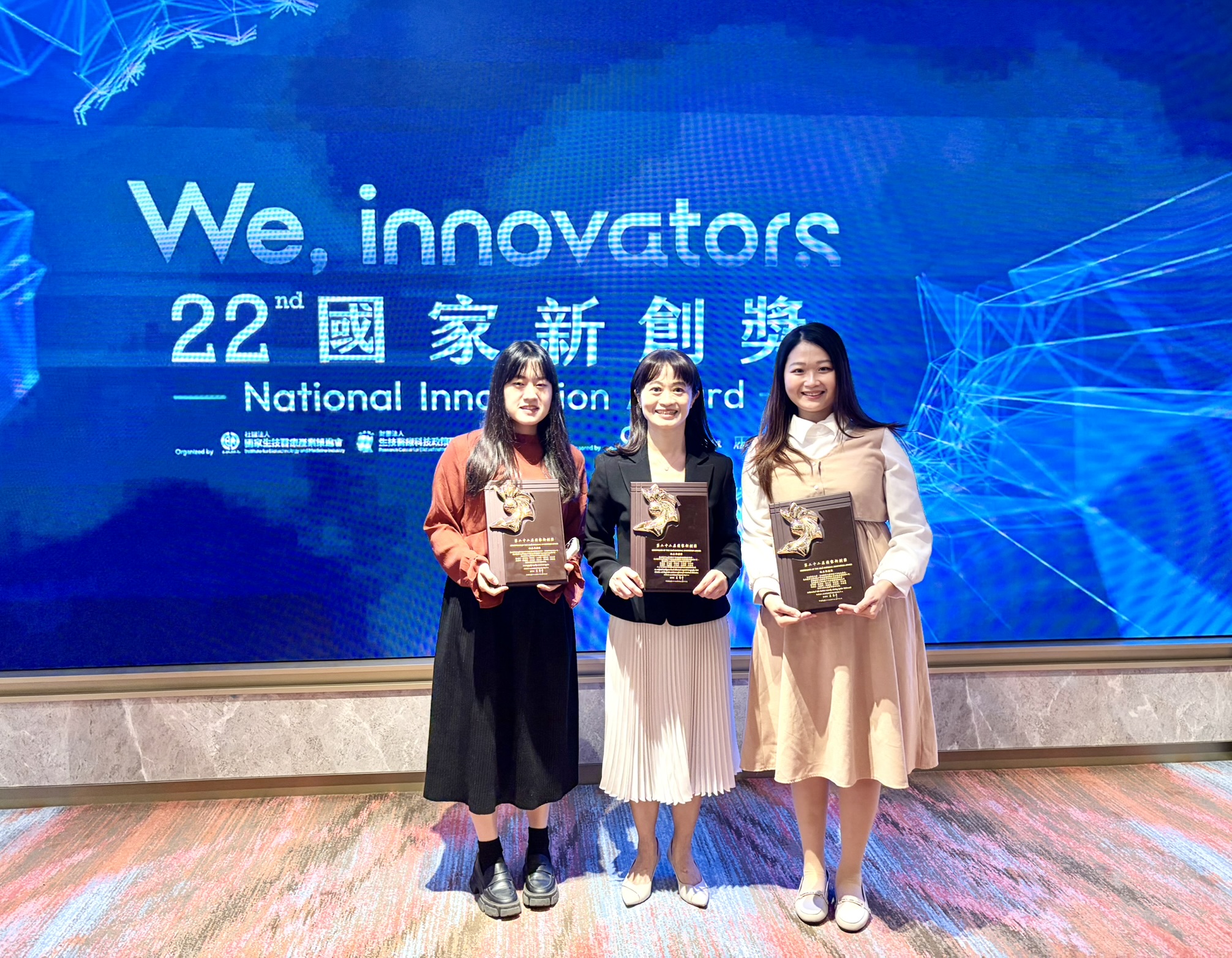
Dr. Hui-Yi Tsai’s team (center) received the Clinical Innovation Award at the 22nd National Innovation Award in 2025.
Conclusion: Building an Innovation Model that Connects Clinical Practice, Academia, and Industry
This case demonstrates that the critical challenges clinicians encounter in daily medical practice are important research questions worthy of deeper investigation. Through interdisciplinary integration and a systematic approach, such challenges can be transformed into research directions with both academic depth and practical innovation value. At the same time, with the support of KMU’s well-established translational cultivation and technology transfer mechanisms, research outcomes need not remain limited to academic publication. They can be further advanced into product development and clinical application, achieving the essential transition from knowledge creation to real-world value. This model presents a complete translational pathway centered on clinical needs, linking academic research, technology development, and industrial application.