
-Drug Development and Value Creation Research Center-
Cardiovascular disease remains the leading cause of death worldwide, with antiplatelet drugs—commonly known as blood thinners—playing an essential role in prevention and treatment. However, standard treatments like aspirin carry a major drawback: a high risk of bleeding. While they help prevent blood clots, patients are constantly exposed to the danger of serious, uncontrolled bleeding from everyday injuries. To resolve this dilemma, our research team successfully developed a highly specific "anti-PAR4 monoclonal antibody," offering a promising breakthrough for cardiovascular medicine.
(1) Importance of the Research Findings: Technological Breakthrough and International Recognition
- Targeting the Right Switch (PAR4): The study zeroes in on a key receptor known as "PAR4." Inhibiting PAR4 specifically shuts down pathological clot formation while preserving normal, life-saving clotting (hemostasis), significantly enhancing safety.
- Overcoming a Long-Standing Hurdle with Vaccine Technology: PAR4 is a complex "seven-transmembrane protein." In the past, traditional lab-purified proteins often misfolded or degraded, making it nearly impossible for the immune system to recognize them and generate effective antibodies. Instead, our team adapted the mRNA lipid nanoparticle (mRNA-LNP) technology widely proven in vaccines. By delivering mRNA instructions directly into living cells, the cells produce the receptor on their membranes with 100% natural folding and proper modifications, while the mRNA itself serves as an adjuvant to stimulate an immune response.
- Published in an international High-Impact Journal: This strategy successfully induced mice to generate specific functional neutralizing antibodies (such as clones 8-9B and 12A-10E) that significantly inhibit abnormal platelet aggregation. These findings have been published in the international journal npj Vaccines.
(2) Impact on the Future: Academic Prospects and Potential for Industry-Academia Application
- A Versatile Platform for "Difficult-to-Target" Proteins: Beyond solving the PAR4 challenge, this approach demonstrates that mRNA-LNP technology can serve as a universal platform to target complex membrane proteins and GPCRs that were previously hard to generate antibodies against, opening new avenues for antibody drug discovery.
- Paving the Way for Safer Antithrombotic Therapies: This anti-PAR4 antibody holds strong promise as a potent, non-bleeding cardiovascular treatment. Following preclinical and pharmacological evaluations, it has high translational potential for clinical trials and commercial licensing—offering patients at risk of heart attack or stroke an effective therapy free from the constant fear of bleeding complications.

Figure 1: Dr. Kai-Wen Ho delivering a keynote speech at the 2026 Taiwan Moderna mRNA Research Day.
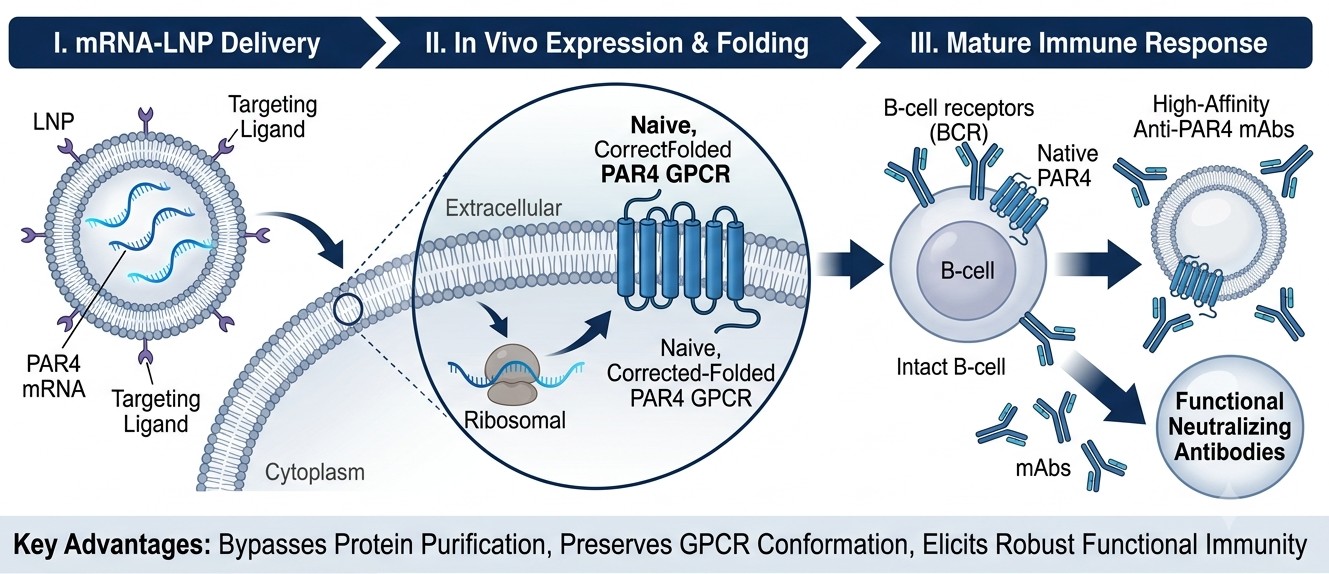
Figure 2: Schematic illustration of the mechanism for mRNA-LNP delivery and in vivo expression of native-conformation PAR4 to induce functional monoclonal antibodies.